Showing posts with label Events. Show all posts

Wednesday, 6 November 2013

Illuminating York

At the weekend mum, Anna and I went for a wander around the sites of Illuminating York; an annual festival of light shows celebrating the city's unique heritage. Limited time meant we didn't get to explore all of the artworks, but the main two we did visit (Clifford's Tower and The Museum Gardens) were captivating projections, bringing to life the familiar buildings. It reminded me not to take for granted the beauty of the architecture we can easily take for granted amongst the bustle of town's shoppers.

Our first stop was at the Clifford's Tower show. This story was of the three Viking Kings of Denmark, who had a strong influence over England, particularly York, at the time. The work was a combination of the efforts of Ross Ashton, an internationally successful projection artist, and Karen Monid, a creative designer of sound art installations. I was very impressed with the way the projections have been created to complement the shape of the tower and its hill. The knowledge of the projections' backdrop added to the atmosphere of the stories- the images present on the tower itself were often suited to the idea of being in a castle interior. I tried to take some pictures and videos, but they don't do the live spectacle justice. However, it's quite impressive to look back on this landmark looking so surreal...
 
After visiting a couple of the smaller, free shows (including one in Coppergate with interpretive dancing!) we finished the evening in the Museum Gardens, where the projected story was a combination of film and animation about the Viking King Eric Bloodaxe. For me, this was the most entertaining part of the night-the humorous narration engaged the audience fully, and persuaded us to stay for the entire show, even though at this point my hands were too cold to operate a camera!

It was a shame our visit had to be so brief, as we missed out on other parts of the festival which I'm sure would have been equally, if not more impressive. The festival brought the cultural side of York alive in a way that appealed to adults and children. It's certainly made me feel as though I ought to take more of an active interest in York's history, and quite proud to be from a place to have such a rich one.

Saturday, 20 July 2013

The Shows- RIPE!

 
FINALLY getting round to doing this post, now that I have a working laptop again!
The end of my final year came to a close and all of mine and my classmates' energies that were left over went into creating firstly the college degree show, and secondly the travelling show, which we created in Madlab.

The name of our show was Ripe, and here is the lovely website the branding team created to advertise us.

College

The college show was a wonderful confidence boost. Nervousness took over as we were on our way to the opening night, not helped by the usual debate of what to wear and how formal we were supposed to be. But on entering the building, I was surprised (in a good way) to find it absolutely packed with people. The hot weather and the crowd turned the floor of our exhibition into a virtual sauna, which is a shame because I'd been hoping to get some decent pictures of myself with my exhibition. Dad even went to the effort of bringing his fancy camera. I think he took a few snaps but I was too scared to see how they looked; I felt like I was melting.
[Ta-dah!]
[My tutor Gary and I with my work]
I think I was unnecessarily worried about how my show would turn out. Although it wasn't exactly as I'd hoped, I was proud of it. I received lots of compliments that evening, which I probably received very awkwardly (I hope not). Seeing as this was a project based on a childrens' fairytale, it was nice to hear that some of the children looking round appreciated it- a friend informed me that she heard a child say "Woaaaaw..." as they walked past. I couldn't get a better compliment than that. Over the week that passed my little pocket of business cards disappeared too. It's flattering to think that people have a little piece of me either in their wallets or pinned up somewhere in their home.
 
As finishing my work took so long (due partly to unhelpful staff) I didn't have the benefit of a carefully discussed pre-planned layout to work with when we were putting up my display. Jo saved me a place with two boards, so I wanted to try and make the most of this. I had the idea that my show should be partly like a memorial to my main character, Mr. Wolf. I hope that people understood this joke....otherwise the flowers in front of the framed picture must have seemed a random addition to the work displayed on the walls. The positioning of the boards meant that my table fitted quite nicely in the middle though, and I made it a little more at home with a rug on the floor too.
 
Jo helped me decide on the inclusion of the 3D objects on shelves. At first I was planning on not including any of the 3D elements-in my mind I thought it was more important that the 2D pieces spoke for themselves, seeing as the 3D elements had been created with this format in mind. I didn't want it to be a fine art show that ended up being half sculptural- my intention had been to create a book (which I WILL complete soon), and I was proud of the fact that the images had worked well in the form I'd intended, as illustrations that told a story, not just objects. However, in the end I agreed it would be a shame for people to not see the characters that had taken so much of my time to create. Having them placed neatly in line with the 2D pieces was a compromise I was happy with, and they did get a more appreciative reaction than I imagine the 2D work alone would have done.
 
The decision to mount the work on foam board was another helpful suggestion from Jo. I explained I didn't want each individual piece to be framed. I didn't want each piece to be 'glorified' alone because they were supposed to be together, seen as a whole. The foam board was a simple way to make them slightly more sophisticated than blue-tacking-a-poster-on-the-wall standards, without appearing too formal, and it did look neat once we'd carefully positioned them all up with a mixture of sticky tabs and velcro patches! The printed images on the good quality paper came out very nicely too; slightly glossy like a photo. I'm also glad for the lack of frames as I didn't want viewing them to be spoiled by reflections on the glass-something which always frustrates me at exhibitions.
 
I remain regretful that I didn't achieve entirely what I'd set out to. The book itself should have been the centre-piece of my exhibit, placed proudly on the table in the middle for people to read. I wouldn't change the pieces of work that are up there, but I feel like they needed the addition of the story words I'd written, a few examples of the vignette ink-drawn images I'd intended to include, and a more carefully planned out layout to really show off my full potential. I'm treating this experience as a valuable lesson rather than a set-back though. Everything I've done on this course that's left me feeling disappointment in myself has only made me more determined to keep improving in the future. And get this book finished! I owe myself that.
[Paul, me and Gleavsie outside the show]
[Got my hands on one of Hannah's t-shirts from the show shop]
Madlab
 
Bringing down the work at college did not mark the end, it simply set the start date for the work towards the next show. I'm very grateful to the team of graphics students who worked extremely hard to find us a venue, and manage the creation of our show in Manchester. I went with a few other students to help spruce up the paintwork in the building before we were all set to go in on the morning of the exhibition day to re-create our show spaces. Another very important part of the preparation were the invitations to local design agencies. The team came up with the idea that we took little 'ripe' fruit salad trays around to hand out to these people with their invitations. Bryony, Kat, Paul and I spent a day buying and chopping up the fruit for this purpose! I wasn't able to assist on the day when the invitations and fruit trays had to be delivered, but I heard that they got a fantastic reaction, and the agencies were impressed with the thought behind it.
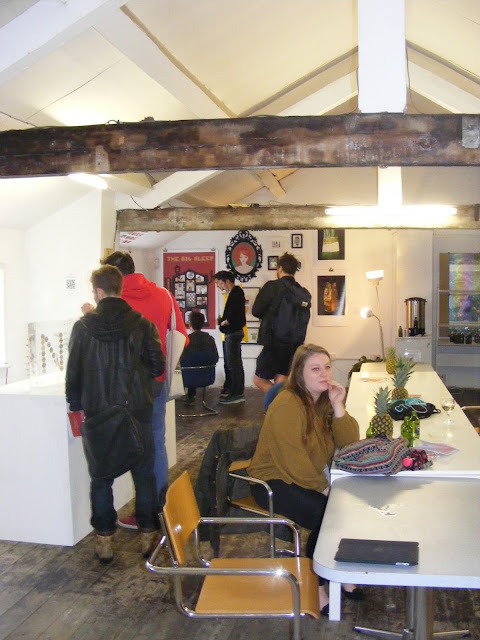
 
[Bought myself a Hannah Sumbland t-shirt this time!]
 
 The opening of the show was a little disappointing. It was slow to attract people for a while, but gradually more people came in to have a look. My space didn't seem to attract as much positive attention as at the college show, and very few of my business cards got taken this time. I wasn't too disheartened at the time, but now I worry that it does reflect the unlikelihood of my work's popularity in the illustration industry. People in general seem to be more attracted to illustration work that is drawing based, or graphic looking. In my experience, there is most respect for detailed work, done by hand, but not made and photographed like mine. It's encouraged me to concentrate on building up a better collection of drawing-based work to include in my portfolio and on my website, to hopefully make me appeal to a wider audience (or an audience at all!). I would love to be able to create unique work and for that to be in high demand, but I feel like I'm making life too hard for myself. My tutors encouraged me to stay individual in my approach and try and carve my own niche way into the industry. Although I would love to be able to achieve this, I don't want to attempt what feels impossible right now, especially when I do miss the drawing.
 
The last night of the travelling show was a sad occasion- it was the last time Bryony and I might be seeing some of our classmates as we were set to move home the next morning! Because of this, the free drinks were flowing, and the atmosphere was bittersweet. I looked around at all our year together and there was this warm feeling, like we were a team and we were really proud of each other, but it was all ending!
 
Packing up and going home...


Friday, 26 April 2013

Hothouse Taster Day

Today I made a lone trip to Preston to attend a workshop for emerging designer makers:
an intensive programme of tips and advice especially tailored for craft makers wanting to set up in business and develop their creativity.
I was a little nervous at the thought of going alone (and this was not unfounded; I did manage to get lost on the way from the station to the church the workshop was held in!) but the advice and atmosphere was definitely inspiring and worth the journey.

The morning began with an introduction from Charles Hadcock (the chairman of Creative Lancashire). He spoke about the value of creativity in modern society; its influence on culture. It is a viable commodity, despite it being an industry that is not widely as appreciated as it should be. He explained that because of the 'death of manufacturing',
the hand of the maker has never been more interesting to the public than now.
Art and creativity is a growth sector, and people trying to make their living in this industry must be armed with the knowledge to develop their practice from a commercial and business perspective. As the business develops, so does the practice itself.

Next we were introduced to Madeleine Furness (the maker development officer of the Crafts Council). She spoke briefly, following on from Mr. Hadcock, about the tenacity required to carry a business. She explained about the Craft Council's purpose: to nurture practitioners and encourage people to study crafts; supporting a large range of disciplines, the collaboration of practices and the opportunities that can generate therein.

The following (and arguably, most important) speaker of the day was Alison Branagan, an extremely experienced and motivational individual. She began by asking about her audience, calling out for people of certain disciplines to raise their hands and make themselves known around the room. At this point I felt extremely intimidated by being somewhat out of place amongst the mixture of ceramicists, jewellery makers and textile makers. However, the presentation was engaging and I'm sure will prove to be useful, even to someone in a narrower field than traditional craft areas, such as myself.
"Don't forget to have a look around at the tapestry, stone and stained glass- we're sitting in a museum of craft in this Minster."
She moved on to the importance of experience: creative work placements, part time jobs related to our practice in some way, internships (as long as we don't get stuck being someone's assistant for more than a couple of weeks). It is essential to get references from these. Learning to be flexible about future opportunities is also important at the moment; it is not always going to be realistic to expect to be able to follow the narrow path many university courses will steer students towards. Touching on the option of post-graduate education, she advised that we didn't rush into doing an MA course. It's best to get as much knowledge about what you want to do as possible first, and if it's an appealing option after careful consideration, you should take time to browse places to make sure the course is right for you, especially with the current high price tags.

Other pointers:
Being naive does you no favours in the world of commerce.
  • Learn about copyright and trademarks! Do not put images on facebook as they then have the right to do whatever they want with the files in the future.
  • Invest in a calendar- a year planner, specifically, so you can easily plan ahead for promotion and commissions.
  • Don't rely on luck- use your degree show as the launch of your career and think carefully about relevant people to invite.
  • Identify what you want to achieve-make a plan involving the people you need to help you get there.
  • Avoid distractions and time drainers. Think seriously about the value of time.
  • Be organised and well-prepared- focused and ready to react to opportunities.
  • Plan with mind maps.
  • It is not good for the mind to try to do a million things at once! Remembering to have some quiet time to yourself each day is important.
The 7 steps to starting up a business:
  1. Research.
  2. Advice and support.
  3. Business plan.
  4. Funding.
  5. Open business account.
  6. Accountant/Book keeping.
  7. Register as self-employed.
Networking:
  • Be ready for every situation where there is the opportunity to participate socially to create new opportunities and carry existing ones forward.
  • Keep a mind map of connections- this can keep growing.
  • Talk to people on the phone when possible. Designers are bombarded with emails from recent graduates trying to make their own opportunities, so they can't begin to respond to everybody this way.
  • Don't get drunk at networking opportunities (ha ha).
  • Be aware that some people are not willing to share their contacts. Professional jealousy can mean people want to keep their own lists a secret.
  • Get onto professional networking sites, but try and limit these to around 3-5.
  • Keep websites/blogs/etsys professional looking- i.e. professional photos when possible.
  • Register with Creative Lancashire. (and look far and wide for other regional support networks).
It's not what you know. It's who you know.
Education and business success are not necessarily related (e.g. Damien Hirst has very limited artistic talent but he knows lots of people and has become very rid from this philosophy).

Business planning and professional practice:

  • Seek advice from lots of people- mentors, workshops like this one, professional business advice, accountants.
  • Try and become a member of a professional body after graduation- it correlates positively with success.
  • Find out about insurance (public liability/product liability). There are people out there who will take whatever chance they can to sue!
  • Be careful what you post on blogs/facebook if things need to be commercially secret.
  • TIME- understand it and its uses.
The next speaker was Bev Lamey, the principle lecturer for MA Surface Pattern Design at UClan. She spoke mostly about the facilities at the university, which was all very impressive but not something particularly useful to me. 

Angela Mann, of the Great Northern Contemporary Craft Fair was next. She explained all about the event, something which I have heard of before, but hadn't considered wanting to possibly take part in until now. The fair focuses on supporting new Northern makers in particular, as well as graduates and other specific groups.
The benefits are:
  • Being selected proves the quality of your work alongside many other makers (confidence boosting!)
  • Sales from work.
  • Networking.
  • Access to trade, buyers, press and over 6000 visitors.
  • Collaborative opportunities.
  • Guidance to the future direction of your work (i.e. what sells and what doesn't).
  • National marketing campaign gains attention for work at the fair- adverts in trade journals, glossies and regional press, city centre and lots more.
Tips for applying:
  • Read the guidelines thoroughly.
  • Don't forget 50% of applicants are rejected.
  • Selection is based on images as judging is done very quickly.
  • The panel look for quality, consistency, cohesive collections, innovation and how sellable the work is.
  • Mixture of statement pieces and more affordable work.
  • Images need to be 300dpi in print, 72dpi for web use...
  • Make work appear professional. Many photos used for entries are not suitable for advertising campaign images, so if it looks impressive yours could be chosen!
  • Think carefully about pricing, equipment needed for displaying the work, promotional materials you will bring.
At the fair:
  • Be friendly and approachable- you are most likely to engage an audience of potential buyers if you're at their eye level and talk to them while they browse.
  • It costs £375 for 'new makers' to get a standard sized stall (+ £20 to be featured in the catalogue).
  • Graduates get free stands, but places are very limited.
  • Around 30% of people at the fair get commissioned by galleries.
Jane Dzisiewski was the next speaker, and a participant in the Hothouse programme in 2011/12. She has had 3 years in business since then. She introduced her talk with a summary of the Hothouse programme itself:
  • Support for emerging makers.
  • Focuses on business and creative aspects equally.
  • Focuses on traditional crafts mostly.
  • Cohorts run January-June 2014 with applications received by the end of July 2013.
  • Find the application details at the Crafts Council website.
She went on to tell us about her business development and how becoming savvy with the internet side of things really helped her progress. Such as:

  • Using a free app called 'buffer', which links social and professional networking sites together, allowing you to manage them all together (which saves time and having to re-write statuses etc separately).
  • Having an online portfolio has allowed her to tell her work's story without having to be there herself to explain it. (so, she recommends using images that are revealing of the creative process, from start to finish).
She also felt that professional development has to be an ongoing process to make the best of yourself. 
General tips:
  • Putting yourself and your work at the centre of your practice is essential (i.e. don't become overly involved in helping others/collaborating if it is really holding you back).
  • Plan seriously for the future you want.
  • Make your own opportunities.
  • Regularly assess yourself and 'fine tune' occasionally.
  • When blogging, think carefully about the use of titles and image captions- what are people likely to search for on google? You can gain a lot of attention from people following pictures back to you.
  • Watch this video of Neil Gaiman.
The final speaker, Rachel Kelly, had these additional tips:
  • Challenge yourself to learn new things all the time!
  • Always seek an audience for your work- you can't confine yourself to a studio working for yourself.
  • Have a sentence, 50 words, and a page about your work all prepared to save time when contacting potential clients etc.
  • Keep computer files super organised- use this as a procrastination if you must procrastinate.
  • Have email templates for replying to people if messages begin to become overwhelming. 
  • Be focused on your work. Don't be distracted by your phone or computer.
  • Concentrate on your own business development before collaborations.
  • Be inspired by your surroundings and use the facilities available to you (galleries, museums, libraries etc).
  • Keep a growing address book of professional contacts and organisations for the future.
  • Attend more events like this one!
  • Understand your work and where you want it to go.
At the end of the day everyone seemed a bit exhausted by all the information we'd absorbed. My overall impression of the day is that it was aimed predominantly at traditional crafts people, therefore wasn't entirely relevant to the direction I might take after graduation. Nevertheless, I did get very useful tips for how to approach becoming freelance and make a living from my work independently; either through self-publised work being sold on my own site or at events such as print fairs and craft fairs.

Tuesday, 23 April 2013

The Fair


Previously I hadn't realised that this was such a high profile event! Inside the venue it was overwhelmingly warm and busy, and the stalls were packed tight. I felt intimidated by the professionalism of the work on sale compared to the items I had donated, but the prints and zines that my fellow students had contributed looked right at home. After arriving and seeing how our stall was looking, it was clear that we wouldn't be able to squeeze in alongside Paul and Kat behind the table to assist, so we wished them luck and mingled around the northern quarter for a while. 

After lunch at the Nexus Art Cafe we returned again to see how our stall was doing. It was a little disheartening to see that none of my work had gone, and I was a bit worried that it was priced too highly for people to be interested. Paul mentioned that lots of people had been intrigued by my hand-crafted animals, picking them up to inspect but seemingly not enough to hand over money for them. There was a bit of debate over the issue of pricing, which was settled with the idea that people would pay a high price for things that were made well and seemed 'limited edition'. Although I think that we should have brought the price of my animals down, it was encouraging that my fellow students appreciated the effort that went in to creating them to value them quite expensively.

Friday, 12 April 2013

Manchester Print Fair 2013

For the past couple of weeks I've been preparing work to sell, along with fellow illustration/graphics students, at this event. The money raised from this will go towards the funds for our degree show outside of college.
I have contributed a few hand-made animals and hand-bound notebooks. I'm a little nervous about whether or not my things will sell amongst the very professional looking graphic prints people have been producing! But hopefully a little diversity isn't such a bad thing.
Only tomorrow can tell what will happen...

Tuesday, 18 December 2012

The Paper Cinema


A couple of weeks ago I went to see a live re-telling of the Odyssey by the Paper Cinema, at the Contact Theatre in Manchester. I tagged along with one of my tutors and a group of first years, but it was so full that I had to squeeze in a seat on my own. However, there wasn't a moment of boredom once the show began. It was stunning!

I wasn't sure what to expect, as I'd never heard about them before or seen any of their work, but I was intrigued by a short video about them, which, teasingly, gave very little away.
“The Paper Cinema is an illustrated song, a shadow, a smoke, a mirror, a puppet show, a cinema show, side show, magic show, a show and tell, a show off. It exists in the meaning of live music and live drawings.
Best to see The Paper Cinema with your own eyes…”
-The Paper Cinema 

Here is a trailer for the show. In my opinion, it doesn't quite do the quality of the live experience justice, but it introduces the viewer to the set-up: there are puppeteers who control the cut-out characters and scenery in front of a camera, which is projected live onto the main screen above the stage, while a team of 3 musicians perform live music and vocals for the soundtrack and sound effects. One of the puppeteers drew characters live during the opening sequence as well.

There wasn't a single part of the performance that didn't seem to require incredible talent to pull it off, especially as the show was so long (their first feature length story) and no visible mistakes were made. The puppeteers, as well as organising the many cut-outs that were used, had to carefully manage the composition of the images in the camera shot (a few times I spotted them looking up at the big screen to check the positioning was ok). They used a variety of maneuvers to make transitions between the different puppets in the shot, e.g. moving cut-outs of houses with windows in them closer to the camera so it zoomed into the window and framed a view of different puppets behind it.

As well as focusing on the puppets from a 2d perspective, there were times when the elements became more 3d, e.g. a man shot an arrow into a target, which was then rotated to show an arrow sticking through the card the target was made from. Although details like that did give the show a little more visual variety, it seemed impractical and unnecessary to include more; the 2d set-up was already impressive enough.

And of course, it wouldn't have worked anywhere near as well without the soundtrack and sound effects. The main musical elements were guitar, keyboard and violin. The violinist was also a vocalist and could play a saw; the keyboardist was the main vocalist and could play the drums: and the guitarist had a variety of pedals to layer music during the more dramatic scenes. I'm sure I've forgotten other bits and pieces. A few times during the show I found myself distracted from the events on screen by the musicians; it was hard to believe just the three of them could create the sounds and music that they did. The main vocalist I found particularly fascinating because of the diverse quality of her voice; how she could provide the eerie, haunting singing of the sirens then change to a deep guttural scream for another scene showing a storm at sea.

When the show ended the applause was very loud and appreciative. A few people even rose from their seats as they clapped. The audience was invited to meet the members of the Paper Cinema team after the show, but unfortunately I had to leave rather quickly (and I think there will have been quite a queue!)

For a better written and more extensive review of the show, I would advise reading this article by Harry Chapman of The Arbuturian.

Thursday, 29 March 2012

LONDON ADVENTURE! Including visits to the National Portrait Gallery, the Haywood Gallery and 'Pick Me Up' at Somerset House.

On Thursday morning I set off to Stockport for a two hour train journey to London. My trip started well- the woman sitting next to me on the train kindly donated me the magazines she had already read!

Bryony, Jadine and I bought day tickets on the underground and set off to Leicester square. Our first stop here was at the art shop on the corner towards the National Portrait Gallery, where there was a big sale! I bought a discounted A5 sketchbook and a much-needed 2B pencil.

After that, we headed straight to the National Portrait Gallery. I knew I had a limited amount of time here before we needed to head to our time slot at the Shrigley exhibition at the Haywood Gallery.

Here are some of the notes I made:

As you can see, I only managed to get around a fraction of the portraits in the gallery before I had to depart. When I see a piece of art that really captures my attention, I do like to make the most of it, especially in places where taking photos is forbidden!

After underestimating how long it would take me to navigate my way to the Haywood Gallery, I finally arrived    with only about 40 minutes to spare in my hour long time slot (unfortunately largely due to me wandering around outside Waterloo station like a little lost lamb, until I found the very helpful street maps which were dotted around the street).
Of course, pictures weren't allowed here either, so I pulled out my notebook and tried to record as many observations as I could manage.
After finishing my walk around the exhibition I realised too late that I had missed some of the rooms! But my time slot had run out and I had arranged to meet my friend Amber, which meant another tube journey from Waterloo station to Piccadilly Circus.

We had tea at a 50s diner- it was the most amazing veggie burger I've ever tasted! (Accompanied with a big glass of water after the long, dehydrating day)...And not forgetting the chocolate and rum milkshakes. After a long catch-up we left and went for a wander round a few shops, including the Rainforest Cafe where I couldn't resist buying a couple of presents from people. We also got a very informative lecture from a scary talking tree:


The next day Amber treated me to Reese's peanut butter cups cereal for breakfast, bought the previous evening from a newsagents that had American food in it. I was tempted by the coconut flavoured m&ms but they were too much money! 

On Friday morning I got up early to make it to Somerset House for the illustration exhibition event 'Pick Me up'. I stayed for two hours wandering around the building. The amount of work there was so overwhelming! 
Lobster 2002
Paper, glitter paper and Decopatch paper
by Zim & Zou
More of the display by Zim & Zou
(warning: text is in French!)


Rachael 2010
Giclee print
by Paul X Johnson

Lear Gaukur 04 2011
Digital print and gold leaf
by Kristjana S Williams

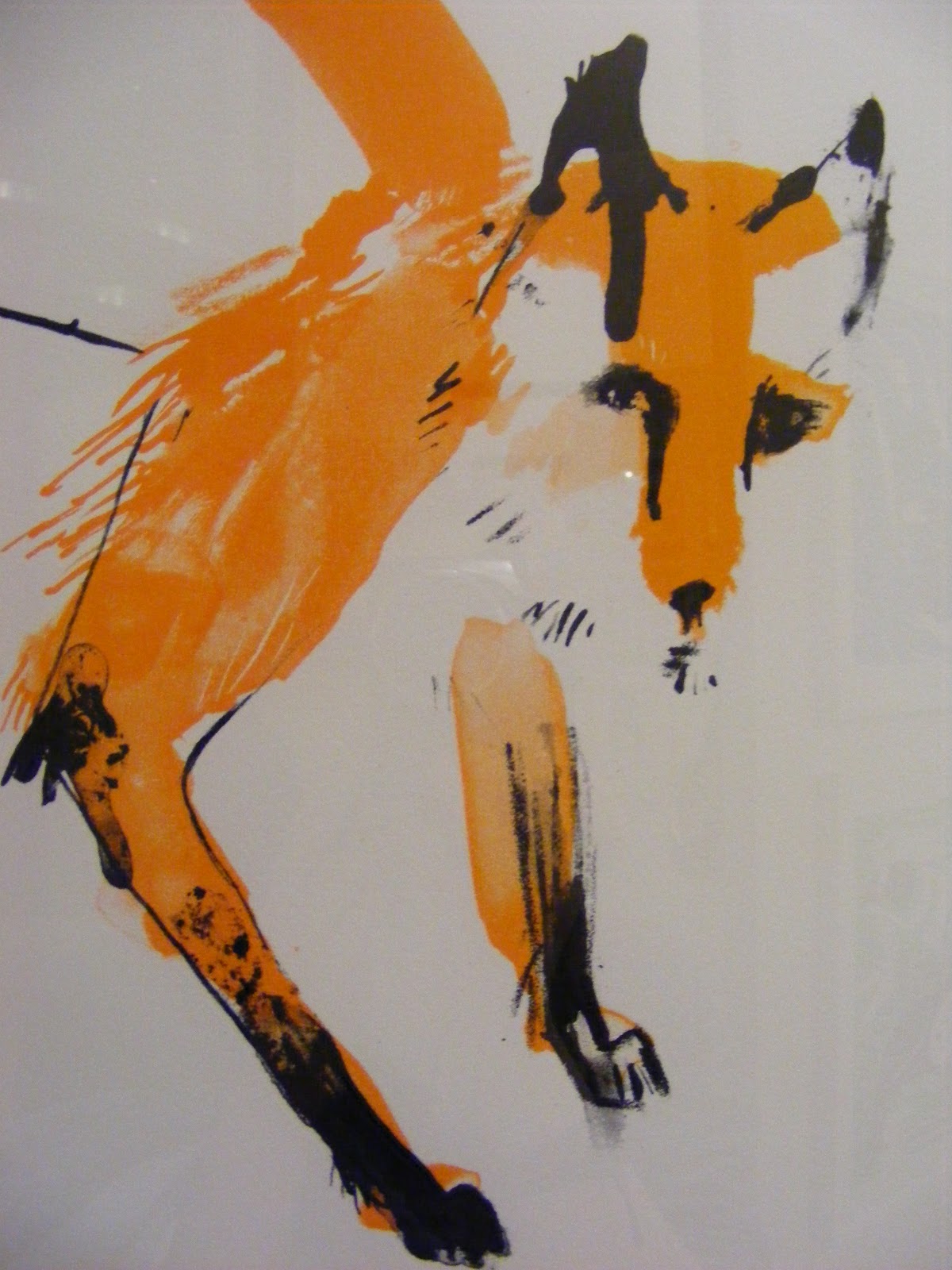
Fox by Sarah Maycock
Fighting Tigers 2011
by Sarah Maycock

Pieces by David Sparshott
(didn't catch the names unfortunately!)

Detail from a piece by Tim McDonagh.

This isn't the style of illustration I would usually admire, but this caught my eye as it was so overwhelmingly detailed and difficult not to be impressed by!  The line work is very elegant and the different thicknesses of black lines help to make the images 'pop' out from the background. It also seems quite decorative; reminds me of the floral wallpaper we had in our old house. I wonder how long this took to design? It looks like the work of someone capable of becoming completely immersed in their work, like the enjoyment of their drawing is evident (which, to me, makes work much more enjoyable to view).

When I went up to the next level, the atmosphere changed dramatically. The room was decked out with displays by different illustrators and illustration groups, most of whom were there in the room, chatting to people about their work and selling various pieces and more affordable merchandise.

Warbler by Jim Spencer
A3 Giclee print
Edition of 50

This little one was simple, beautiful and delicate-my favourite kind of watercolour!


The display table of Cachete Jack.
I had a good look through the various books on the table and enjoyed the diary-like style and playful humour they conveyed (thoughts and words accompanied with sketchy images). It's quite similar to the way David Shrigley approaches his creation of images with a statment to accompany them.

(I highly recommend it!)

There was yet another level with smaller rooms, displaying framed pieces, books, and other merchandise. I spent some time wandering through the different rooms trying to decide whether or not to buy a particular book, Cardigan Heart by Lizzy Stewart. The paying system was a little bit strange.